



Puzzling (Mis)adventures: Volume 11: Magrunner, Project Temporality

Project Temporality
Rob Franklin
What is it they say? Nothing’s ever new, it’s all just a bit of history repeating? Truer words were never spoken when applied to a game like Project Temporality, a game of repetition not only in its level design but also in its aspirations. In this time-bending puzzler, you’ll be repeating your efforts via multiple timelines to solve platforming problems as you play through a story that will feel awfully familiar to fans of the infinitely superior Portal series. Even with the repetition, the puzzles work well, but the story will leave you with little desire to sit through it again.
Project Temporality is a fairly low budget affair set on a space station orbiting Jupiter. You won’t find flashy cutscenes, intricate plotting, or even voice-overs in this game. There’s not even any real lead-in or introduction; instead, hitting ‘start game’ on the menu takes you straight to your character standing alone in a darkened room. You’re a Journeyman Project-looking astronaut given the label of “87”, fated to run through the space station undertaking tests for a mysterious Admiral so he can judge if you are fit for purpose (exactly what that purpose may be is left deliberately ambiguous.)
There’s very little in the way of backstory for your character, other than you being the latest of a long line of test subjects in Project Temporality who must try out a new form of time manipulation equipment called the TP implant. This device allows you to rewind time and send a time clone to repeat that action, leaving you free to perform a different task – the clones are like helpers, but helpers fixed to the rails of the action you just performed. You can send up to 11 clones out on a given level and they don’t expire; they’ll simply stand still at the end of their action sequence with no way to claw them back if you’re running short by the end of the stage.
Using the mouse to look around the 3D environment and the WASD keys to move, you’ll leave the initial room only for a text box to appear front and centre announcing where you are and what you must do; a picture of a grey-haired older man accompanies it. This is Admiral Melville, one of only two characters who speak directly to you. With no replies possible from your character, speech happens through these text boxes, which just interrupt you as you run from one puzzle to the next.
You’ll make your way through a series of corridors and rooms all decked out in futuristic space station chic – somewhere between the movie Alien and the Mass Effect game series – before eventually coming across the first of your puzzles. There’s not much going on in the corridors or rooms in between puzzles, aside from the odd document or diary entry that you can interact with to read up on the station’s situation. These all come from various characters you never meet doling out portentous warnings of what lies in store for test subjects, as well as questioning the methods of the powers in charge. This, along with the characters speaking to you, provides the sole narrative framework to the game. Your actions have no bearing on the story and little you do is linked to the unfolding tale; you’re simply solving puzzles.
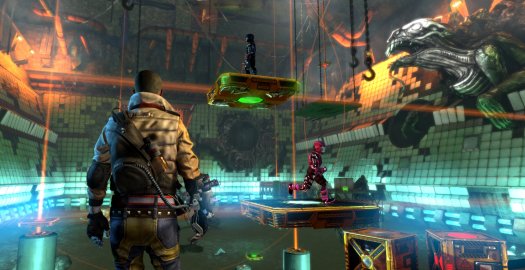
The game is fairly pleasing on the eyes, particularly the lighting: light from Jupiter streams in through the windows, and overhead lights flicker on and off with power cables hanging limply at their sides, sparking sporadically. It’s all moodily lit with trails of what looks like blood along the floor to enhance the sinister setting. Unfortunately, despite its visual flair, you never really feel connected to the scenery around you – it seems more like a veneer repeated ad nauseam: the blood doesn’t lead anywhere, the sparking cables and seemingly complex computers have no purpose, and even Jupiter looks like it’s a star lifted from another game and just given a familiar name. It all feels a bit borrowed and LEGO-like: building blocks stacked one next to the other to make game levels, as opposed to a finely crafted environment that helps enhance the tension as the story unfolds.
This wouldn’t be such a problem if it weren’t for the fact that it has a knock-on effect with the story. There’s no false sense of security or initial impression that 87 is simply running training tests – instead the Admiral talks to you calmly about your tests whilst all around you lay the debris and fluids of former subjects. You know from the outset that something is wrong with your mission, so when the story starts to reflect this you can see the ‘twist’ a mile off. Even the Admiral, at points, seems surprised that you’re continuing despite the carnage, and when the best you can come up with, as a player, is ‘well… this corridor leads to the next puzzle?’ you can’t help but feel somewhat disconnected from the story.
The music similarly doesn’t enhance the experience. It’s some fairly decent sci-fi-sounding electronica, but since there’s only a few tracks set on repeat, the soundtrack doesn’t emphasise the characters’ words with a suitably eerie score, or punch a shocking moment with a resounding audio sting. In fact, the sound design is pretty limp throughout, with very few effects and those that are used being fairly comical – especially the jumping sound.
Despite its budget production and narrative shortcomings, however, Project Temporarility impresses when it comes to puzzle design – and this is, after all, what you’re playing it for. To begin with you’ll initially control the actions of only one clone – programming it to press buttons in sequence, allowing you to jump from platform to platform. But fairly quickly, the time bending mechanics become more complicated as you’re managing multiple clones all needing to be set to jump, press buttons, revolve lasers and grab keys in unison – a learning curve that may put off those with short attention spans. Think of it as a co-op game where you have to plan out the actions of all your teammates in advance of running it yourself. People with programming knowledge will have the perfect brain for this kind of puzzle – you’re effectively setting up your commands, then hitting ‘run’ and hoping it all meshes together. Given their disconnect from the story, few levels stand out as particularly outstanding, but the time warping premise remains entertaining throughout.
The engine is remarkably robust for puzzles like this. I imagined all sorts of slow-down as it tracked the action of multiple clones all at once, but there was no evidence of this at all. As you run around, clicking the left mouse button enters time warp mode; this allows you to freely rewind the actions you’ve done so far (quite literally – it even has a rewinding VHS sound effect to accompany it). Once you’re back to a point where you can perform another action, simply right-clicking will send a clone to perform the action you’ve just done. Similarly, the basic actions you can perform are easy to do, whether making short or longer jumps or simply interacting with hotspots. The setup is mercifully simple, allowing space in your brain to try to figure out the myriad clone assignments you have to set up. My only complaint with the engine is that for a game designed specifically to require precision and timing, your character loves getting stuck in doorways, particularly whilst waiting for them to open, meaning you’ll have to rewind and try the action again. It’s not game-breaking as you can easily rewind, even if your character has become stuck in a piece of scenery by accident, but it can be annoying and could have done with some polishing.
In fact, overall it’s the lack of polish that lets Project Temporality down. It aims for Portal but falls more in line with Quantum Conundrum: a series of fairly well-designed brainteasers given the thin veneer of a story with little-to-no connection between the two. The lack of cutscenes and voice-overs limits the storytelling to a series of text boxes that often prove more irritating than intriguing, breaking your flow whenever they appear. Its puzzles start out promisingly, keeping a good level of creativity throughout, and at roughly eight hours of gameplay it’s a decent amount of content for a budget price. However, by the end the imagination is visibly wearing thin, both in storyline and in puzzle execution, and the whole game ends in a fairly lacklustre way. Each level is awarded stars depending on how quickly you complete it, so there’s an element of replay value, but whilst it’s worth a single run-through for anyone craving a Portal-style puzzler, for those of us that enjoy a decent story with their puzzle-platforming, this is probably one project not worth repeating.
Latest Gaming Articles
All Articles