



Puzzling (Mis)adventures: Volume 10: Monochroma, The Bridge

The Bridge
Claudio Medina
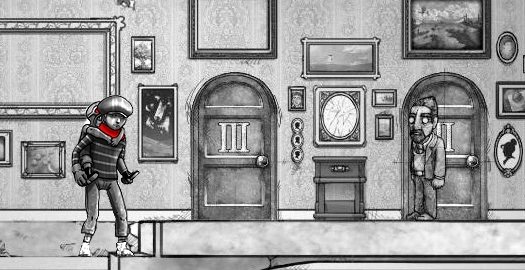
As soon as you enter the black-and-white sketched world of The Bridge, its similarities with other indie games immediately become evident. It has the same hand drawn quality and time-reversal mechanics of Braid, the world rotation controls of games like And Yet It Moves, the disorienting illusions of Antichamber, and even some of the pretentiousness of, well, Pretentious Game. In drawing from all of these influences, however, this clever little puzzle-platformer still manages to stand apart with an identity all its own.
You play as an anonymous intellectual (with a clever nod to Isaac Newton), who finds himself trapped in a series of dream-like levels reminiscent of the Kafkaesque etchings by M.C. Escher, which have taken over the rooms of his house. On each level, you must acquire the key to the door that leads to the next area, with no other apparent motive than to move on. But in this surreal place, physically reaching your objective is always a little more difficult than it seems. The protagonist can only walk left and right (no jumping), but you can use the space bar to reverse time and the arrow keys or second joystick to rotate the whole level. This ability transforms walls into floors, catapults you over long distances, moves barriers and pushes enemies away – or pulls them in, if you’re unlucky. It’s the only way to navigate through the game’s beautiful labyrinthine designs, where there’s no up or down and corridors overlap in mind-blowing ways.
Each level is completely self-contained, and due to their limited scope there is not much exploration to be done. Initially, most of the challenge simply comes from how to get from point A to point B, but as you progress further new obstacles are added. For example, you must still rotate the level in a certain direction to move, but the key is also trapped behind a wall you need to raise by moving a sphere with a scary demonic face over a trigger. However, trying to rotate the level so the ball moves over the trigger may push you away from the key, and the reverse may send the ball towards you, crushing you in the process. In the end, it’s all about timing and being in the right spot.
Other mechanics introduced in later levels are duality and gravity manipulation. Duality works by standing in certain spots marked with a bridge symbol and warping to its mirror position, usually a place that’s otherwise inaccessible, where the character turns white and can only be affected by things of the same color. You can warp between these two points as many times as you want, and it’s often required for solving puzzles.
Gravity manipulation happens behind the curtains of a small structure referred to as “the veil”. I found understanding the veil very frustrating, as the visual cues are not exactly clear and there’s no text tutorial whatsoever. When you enter the veil, you can see your spirit floating away from your body and into some object involved in the puzzle. What does this mean exactly? Are you now in control of the object? Not really. The veil allows you to change the direction in which gravity affects the object you’re “possessing” by rotating the level while your position remains locked. It’s one of the most interesting additions to the gameplay, but its function can be easily misunderstood by the lack of information. A consequence of this is that I solved many of the veil levels without truly understanding what was going on, instead just randomly rotating things around. It doesn’t feel very elegant.
These base mechanics support the metaphysical themes of the game, which are often referred to through verses that appear on screen during different transitions. This text often feels like overkill, however, as notions like infinity, space and time are conveyed effectively enough through the imagery and puzzles themselves, without hammering players over the head with overtly abstract commentary.
Though its narrative may be a bit too heavy-handed for my taste, The Bridge was still a beautiful and evocative experience for me. The designers paid great attention to detail in replicating the feeling of M.C. Escher with unsettling yet mind-bending illusions. Observing lithographs where stairs can simultaneously be inside and outside of a room is one thing, but playing through such an experience, walking behind a column and discovering how it slowly becomes your support as the world spins around you is close to magical.
At times it was as much fun just to stand still and rotate the world endlessly as it was actually playing. This allows time to enjoy the game’s intriguing, ominous soundtrack. There are no more than a few songs, but since the game shouldn’t take more than three hours to finish, the score doesn’t really come off as repetitive – although that’s without taking into account the mirrored game mode that you can enable after finishing the game.
As the name indicates, all levels in the bonus mode are mirrored versions of their original forms, but this time, right from the start they include obstacles from late in the main game to spice them up. The majority of puzzles in the original mode are in the easy-to-medium range, with just a select few feeling like major obstacles, but in mirrored mode everything is considerably more challenging, significantly increasing the game time. This mode has an alternate ending though, like much of the game itself, it raises more questions than it answers, leaving the interpretation up to players.
The Bridge trailer
Overall, despite some minor annoyances with character movement (the protagonist seems to slide whenever the world is slightly tilted) and the somewhat annoying writing, The Bridge is a game that you’ll probably be tempted to run through in one sitting as you keep wondering what the next challenge is going to look like. Its minimal story and self-contained levels may not be enough to hold the interest of more traditional adventure players, but with its slick, black-and-white sketch aesthetics and compelling physics- (and physics-defying) based puzzles, there’s an addictive quality to this mind-bending, pick-up-and-play puzzler to make it worth your time.
Latest Gaming Articles
All Articles