



Puzzling (Mis)adventures: Volume 1 – Braid, And Yet It Moves, and World of Goo

In recent years, the adventure genre has shown a noticeable trend away from puzzles as a primary focus. Oh, sure, there are always new conundrums to solve, but often now they’re secondary considerations, their frequency scaled back and their challenge toned down. Gone are the heady days of text adventures and their equally cerebral graphic brethren, replaced by an emphasis on that hottest of buzzwords: accessibility. One result is the “casual adventure” (for lack of a better term) that we’ve looked at before. To one degree or another, many gamers celebrate this transition as a positive change, but for others the question remains:
Where have all the puzzles gone?
There isn’t just one answer to that question, but one that leaps immediately to mind (rather literally, as you’ll soon discover) is the one you’d least expect… puzzles have moved into platformers.
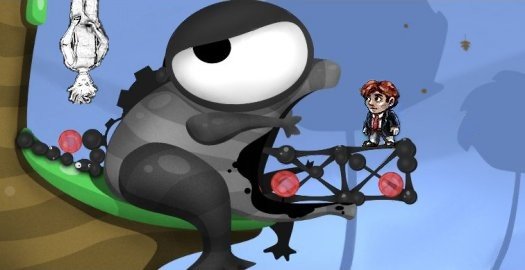
You might think the “puzzle-platformer” is almost an oxymoron – one demanding logic, thought, and strategy; the other reflex, adrenaline, and dexterity. But rather than being diametrically opposed, more and more the need for both skillsets is being merged together in a new form of cross-genre hybrid. Nowhere is this more evident than in three independent productions released in recent months, Braid, And Yet It Moves, and World of Goo. With these games, the “thinking person’s platformer” has officially arrived.
Okay, to be fair, there’s nothing actually new about platformer puzzles: from Lemmings to Lost Vikings to Super Mario, there’s always been some layer of tactical planning involved. Still, as is happening on other fronts, it seems the platforming envelope is being pushed in welcome, intelligent ways, so it’s worth taking a closer look at these titles that oh-so-appropriately take the puzzle-solving experience to a whole new level.
Before we move on, however, let me make clear that these are not adventure games. And unlike the superb genre-defying Portal, the lack of any relevant narrative framework means they really don’t even qualify for honourary adventure status. But on behalf of puzzle fans everywhere, whether adventure gamers choose to follow or not, this article is simply a single, curious step outside of the usual comfort zone and into a brave new world of puzzles, platforms, and a whole lot of goo.
Braid
At first glance, Braid has all the appearances of a traditional side-scrolling platformer… Wait, scratch that. At first glance, Braid appears to be one of the most jaw-droppingly gorgeous platformers ever made. Meticulously hand-painted in a vivid watercolour style, Braid’s luscious landscapes are filled with swirling clouds, chiseled cliffs, majestic mountains, and crystalline caves. Plus a handful of inconveniently-placed ledges, locked doors, walking disembodied heads, keys, and a little dude in a blazer and tie named Tim.
Tim, of course, is you, and he looks like anything but your typical action hero. Which is good, because this is anything but a typical action game. The setup will sound familiar, but the implementation is not. Over the course of six “worlds”, accessed through a central hub in Tim’s house, players must overcome the physical obstacles in as many as eight stages each in order to collect jigsaw puzzle pieces and reach the exit. Braid’s own “How to Play” screen teasingly emphasizes the standard elements, listing only the following:
- Press Spacebar to jump.
- Bounce on monsters’ heads to get higher.
- Collect puzzle pieces
Sounds simple enough, but really that’s just the tip of the iceberg, and precisely where you can kiss all the normal platforming familiarity goodbye. Whereas most platformers make level completion the ultimate goal of each large, sprawling stage, here you can reach an exit merely by walking calmly across the fairly confined screens in most cases. You won’t be able to finish the game that way, however, as the final world is accessible only by collecting each and every puzzle piece in the preceding worlds. And that, to put it rather bluntly, can be pretty freaking tough to accomplish.
While you might think the difficulty lies in defeating monsters and performing outrageous acrobatics, you’d be wrong. There are certainly some tricky jumps along the way, but they’re surprisingly few and far between. And where time is often your opponent in platformers, here it’s your one and only ally. You see, Tim is a rather unremarkable specimen, as he’s only able to climb ladders and make small jumps, and has no weapons to aid him. What he does have, however, is a mastery over time. Or at least, a very unique connection to time, and it’s this connection that forms the basis of Braid’s many puzzles.
Throughout the game, players have the power to “rewind” time at the press of a button (and fast-forward back to the current moment if so desired). Similar to The Last Express and the recent Prince of Persia games in that respect, here the ability is far more pervasive, allowing Tim to go back mere seconds to reverse a bad jump or death, move all the way back to the start of a level if necessary, or stop anywhere in between. Rather than merely offering you a second chance, however, here it’s an integral part of the gameplay, because different elements react differently to the change in time stream. In one world, for example, certain highlighted platforms are immune to the passage of time in either direction, while in another, you can create a shadowy “past” image of yourself that mimics your physical body and interacts with shadow elements accordingly. There are even a couple of “boss” fights, but these are also defeated through time manipulation rather than brute force.
Each world has its own unique element that continually introduces new challenges just as you’re getting comfortable with the last. My personal favourites were the levels in which merely walking left on the screen causes a reversal of time while walking right represents the normal temporal flow (with special acknowledgement of the Donkey Kong-inspired scenario), and for a real change of pace (in every way), the stages allowing you to create a “slow down” time bubble. Clever, clever stuff, forcing you to constantly think outside the box.
In fact, perhaps a little too much so. If there’s a complaint about Braid, it’s that it can start to feel almost relentlessly punishing. The puzzles range from moderately straightforward (which you can probably count on one hand) to the darn-near diabolical (how many hands have you got?). Oh yes, rest assured that your brain will be seriously straining at times to reach that one solution that feels so near and yet ever remains just out of your grasp… only to be followed by the next, as there’s really nothing else to do otherwise. You can move in and out of each world’s levels as you please, and even move between worlds at times, but since every puzzle piece is ultimately necessary, such freedom is only temporary.
The game does little to ease potential frustration, either, almost going out of its way to avoid providing any support. For example, at the start of the game, simple onscreen prompts appear to show you what button to press for certain actions, creating the early impression of user-friendliness. But this is done only for the most basic controls, which are so simplistic as to hardly warrant the guidance. The time element, on the other hand, is never even mentioned, and certainly no hints as to the nature of each world’s “trick” is offered. Of course, that’s part of the challenge and you’ll figure it out eventually, but at times it feels like the game would rather see you fail than succeed, or at least see your patience eroded in the process. If there’s a middle ground, Braid makes little effort to find it, and a little more balance might have gone a long way.
Adding to the difficulty is that some of the challenges themselves are time-dependent… or, well, even more time-dependent than others, in real player time. Switches might begin timers on objects that aren’t yet even visible, or moving obstacles will be past the point of no return before you even know they exist. You can try as often as you like, and the levels are so small that you’ll piece it together soon enough, but some of the puzzles simply don’t seem as reasonable, though none could ever be considered downright unfair.
The controls themselves, at least, are brain-dead easy. Using either the keyboard or gamepad, you’ll have fully learned everything there is to know about three minutes in. I preferred to kick back with an Xbox 360 controller (and since the game was first released on that platform, the configuration was already fully optimized), but the keyboard controls are totally intuitive, so there’s no reason to have any trouble moving Tim around.
There is a reason for Tim’s platforming adventure, though it comes with a significant “but”. Told only through text in a series of books discovered at the start of each world, the tale is ostensibly one of lost love, as Tim is pursuing a princess who was taken from him by a monster when he made crucial mistakes in the relationship. The account of what transpired, however, soon begins to diverge in esoteric directions that makes the narrative hard to follow, which can come across as either romantically poetic or needlessly obscure depending on how mentally fried you are when you reach the next installment. There is good reason for that, however, as Braid purportedly conceals a deeper theme, though I won’t dare reveal the underlying premise here. Mind you, the game doesn’t ever reveal it either, so you may need to do some research online, but if you do play the game, save it for when you’re done.
Regrettably, there’s never any recognizable connection between this backstory and the gameplay. Even delving into the meaning-within-the-meaning, nothing enlightening is uncovered in the gameplay levels, and collecting puzzle pieces has no bearing on the outcome other than unlocking the final world. That said, the ending is a doozy that’s well worth playing through to achieve. Again, I won’t give anything away, but suffice it to say that players will encounter the only truly timed level in the game, followed by the need to re-program your understanding of time all over again.
Not to be overshadowed by the visual splendour of Braid is its soundtrack, which is as diverse as it is excellent. Some tunes sound as if they come from the Highlands, while others are distinctly eastern-flavoured, to name but two of the many different varieties. It’s all very moody, setting a wonderful atmosphere that somehow never manages to feel overdone, no matter how long you spend trying to get that last… bloody… puzzle… piece!!
Braid trailer from David Hellman on Vimeo.
I would be remiss if I didn’t point out that Braid is almost entirely a one-man production, designed by Jonathan Blow with a key contribution from artist David Hellman, making the game a pretty phenomenal achievement. It’s this kind of game that represents the very best of independent development, as it’s hard to imagine such a concept getting the financial backing of a major publisher. But Braid wisely embraces its limitations. It’s a “small” game, and yet it’s unlikely to take anyone less than eight hours to get through it, and that probably includes several peeks at a walkthrough, which I openly admit to taking myself. (Hey, I said I was hard!) That’s because every single moment in the game adds value to the experience – in fact, given the constant manipulation of time, most moments offer multiple sources of value, forwards and backwards alike. And if that doesn’t make sense, you’re all set for Braid.
Speaking of time, it’s funny, but in describing this game, I can’t help but think I’ve been pulled back to another product from another era: a small team makes a new kind of game that challenges the accepted norms of its genre, creating beautiful, serene worlds filled with obtuse, often brutally difficult puzzles and punctuated by a remarkably touching backstory. But no, it’s not Myst this time, it’s Braid. And no, it’s not an adventure, but a unique kind of puzzle-platformer. Beneath the surface, though, where their value truly lies, they really aren’t so different after all.
Page 1 exit reached. Advance to the next level: And Yet It Moves.
Latest Gaming Articles
All Articles