



Sam Dyer – The Art of Point-and-Click Adventure Games

[b]Ivo[/b]: Who are some of your favourite adventure game artists? Did you immediately know which games needed to be included?
[b]Sam[/b]: I knew the games I wanted to be included but they are probably the more obvious choices such as Simon the Sorcerer, Beneath a Steel Sky and Day of the Tentacle. I also knew that certain games had to feature – ones that consistently pop up as shining examples of the genre. These games I knew would be included as they are ‘classics’ and ones that people remember fondly. I’d say my favourite artist is Mark Ferrari. What he did with Loom and The Secret of Monkey Island with the primitive EGA graphics mode is pure genius.
Simon the Sorcerer was another obvious choice for a book about striking adventure game art
[b]Ivo[/b]: Since you spoke with so many different game designers and artists in the creation of The Art of Point-and-Click Adventure Games, which interview stood out most?
[b]Sam[/b]: I really enjoyed our interview with Robyn Miller, as he went into great detail about the Cyan days and creating games such as Myst and Riven. These weren’t games that I played when released, so it was fascinating to read about their creation directly from the main artist and creator.
The following excerpt is from Robyn’s interview:
“We began with the idea that Myst should maintain a believable and compelling narrative and characters. The player needed to feel this world was real and empathise with the characters. Honestly, we had no idea to what degree we could accomplish our dreams for the project, but we felt that we’d have the greatest chance of achieving this stuff if we kept things simple. That meant a simple mystery with the player as the protagonist. One brother was bad, one was good; the player would have to decide between them. Achenar seemed more overtly mad, but we were going to plant clues that Sirrus, the more spoiled and intelligent of the two, had manipulated Achenar to his own sociopathic ends.
We designed the islands and gameplay around this concept over an initial two-month period. Rand and I sat in a room, discussing and sketching. During this, we came up with the idea of linking books and the missing pages. We designed all the puzzles and filled in all the gaps in the story. We did a lot in a short amount of time. There wasn’t a lot of second-guessing because we didn’t have time for that. It was late in our design that we realised the mystery wasn’t entirely working. Players couldn’t or wouldn’t root for Achenar or Sirrus. We needed the twist at the end of the story: the father character – the true and only protagonist. As we tested, we saw that people enjoyed the game, but they weren’t immediately engaging with the narrative. We went back to the drawing board and added elements to help incite the player to action: a note on the path; a recording of Atrus in the ‘fore-chamber’. These things helped immensely.”
No book about adventure game art would be complete with Myst, along with an interview with Cyan co-creator Robyn Miller
[b]Ivo[/b]: Was there anything that surprised you during interviews?
[b]Sam[/b]: I wouldn’t say anything revealed particularly surprised me, but there are some great anecdotes about the early days at Sierra from Jim Walls and Al Lowe, while David Fox and Noah Falstein give some fascinating insights into life at Lucasfilm and described what Skywalker Ranch was like to work at. Overall, I was very surprised by how open and passionate everyone still is about talking about these games. The volume of content and people willing to do an interview was pretty mind-blowing, and it’s a testament to how well loved the genre still is.
[b]Ivo[/b]: We all talk about the big classics from LucasArts or Sierra, but in your book I’m particularly looking forward to exploring some of the lesser-known adventure games you’ve mentioned – even some homebrew games! Can you lift the veil on any of these titles?
[b]Sam[/b]: I was determined from the start to look beyond the obvious LucasArts and Sierra titles. Don’t get me wrong, games such as Monkey Island and King’s Quest are covered because of their brilliance and historical importance, but I wanted to dig deeper. This has meant covering titles such as The Legend of Kyrandia, Heart of China, Touché, Blade Runner, Toonstruck and Gobliiins, just to give a handful of examples. We also wanted to recognise the current point-and-click scene and have interviews and features about recent titles such as The Darkside Detective, Fran Bow, Machinarium, Dropsy, Paradigm and The Lion’s Song. The games we decided to include were determined by research – looking though reviews, digital sales charts and finding out which titles would suit the book. As the book is all about the art, the main criteria has always been ‘does it look beautiful?’ so a game such as The Lion’s Song, with its stylised sepia-tone graphics, was an instant shoe-in.
Beyond the more historical classics, Dyer included many newer indie titles as well, including Fran Bow
[b]Ivo[/b]: What are you most proud of about the book, and what element was hardest to nail down?
[b]Sam[/b]: I’d probably say the Jim Walls interview was the hardest to get and I owe Robert Lindsley a big thanks for this. Al Lowe was already contributing stories about Sierra but I really wanted someone else to bolster the content about the company. Robert helped me reach out to Jim and I’m incredibly proud of that interview. You don’t often see him interviewed so it feels like a special one. I’d say that overall, I’m most proud of the quality of the content as I feel like the bar was seriously raised for this book. I think that it appropriately pays homage to this wonderful genre and does it justice, something that was my aim at the beginning. That’s incredibly satisfying. I also need to give a massive shout out to Mike Bevan and Damien McFerran, as those guys took care of so much of the interview and editorial content and did an amazing job.
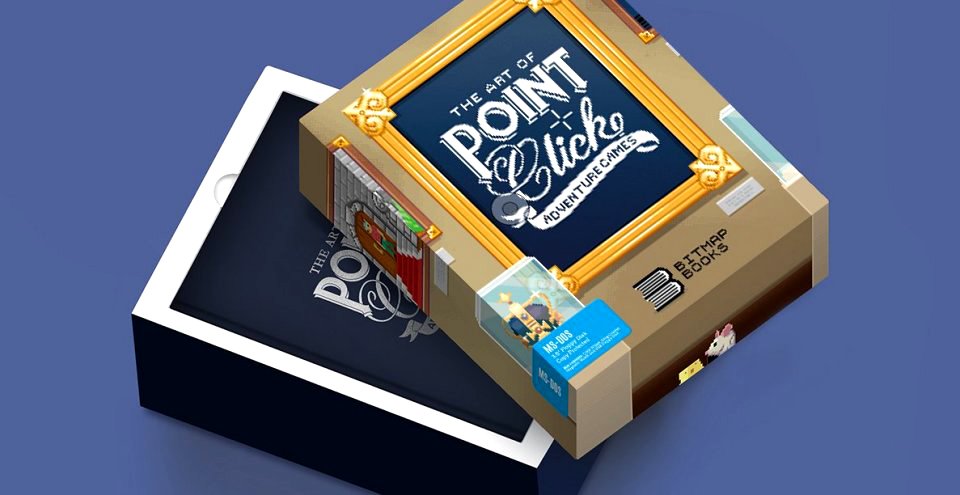
[b]Ivo[/b]: The collector’s edition includes great touches, and the box looks gorgeous too. Could you tell us a bit more about the two different editions?
[b]Sam[/b]: Both editions of the book are hardback and come shrink-wrapped. The standard edition is ‘just the book’ and the collector’s edition is the same book, but housed within a DOS-Style game box with some cool extras. The collector’s edition is limited to the pre-order period so after July, this will never be available again. The cover of the collector’s edition box is created by Paul Conway (Spooky Doorway, The Darkside Detective). We wanted to create an art gallery scene with paintings and exhibits that related to classic point-and-click titles, such as a three headed monkey sculpture and grail within a glass cabinet. It’s a bit of fun and looks great wrapped around the box. Within the box also comes a series of ‘feelies’, such as a Dial-an-Interview code wheel, which is a play on the classic ‘Dial-A-Pirate’ code wheel and acts as a fun little page number finder for interviews. There’s also a USB drive in the shape of a floppy disk that contains a PDF of the book and some other goodies, an acrylic grog drink coaster, and finally a magnetic word game which consists of a series of individual magnetic words such as ‘Open’, ’Give’, ‘Speak’ and ‘Wizard’ – these can be arranged to create some fun dialog arrangements.
[b]Ivo[/b]: Any future plans for other books?
[b]Sam[/b]: I’d like to do more books around the subject of adventure games, as it’s a subject I’m very passionate about. We are actually going to be publishing a printed version of the CRPG Book by Felipe Pepe later this year, which is going to be great. Beyond that, our next visual compendium will be focussing on the SEGA Master System and officially licensed by SEGA.
[b]Ivo[/b]: Thanks a lot for taking the time. We look forward to the launch of the The Art of Point-and-Click Adventure Games in August.
That’s it for our interview with Sam, but what’s with all these words for a book about art, you ask?! You’re absolutely right, so flip the page for a bigger sampling of page layouts.
Latest Gaming Articles
All Articles