



Queue Queen Explained: Fast-paced card counting

Considering the success of the rogue-like genre in recent years, and the number of entries in the genre based on cards, you’d think there would be few viable card games left to base games on. Queue Queen subverts this necessity by creating its own game, not basing its mechanics on an already established ruleset.
When it comes to “rules” in Queue Queen, it’s anything goes. The level of ridiculousness can be immense here, so to prepare you for the absurdity, let’s elaborate on what exactly makes this game unique, how it stacks up (excuse the pun) against other entries, and the team behind the game.
What is Queue Queen?
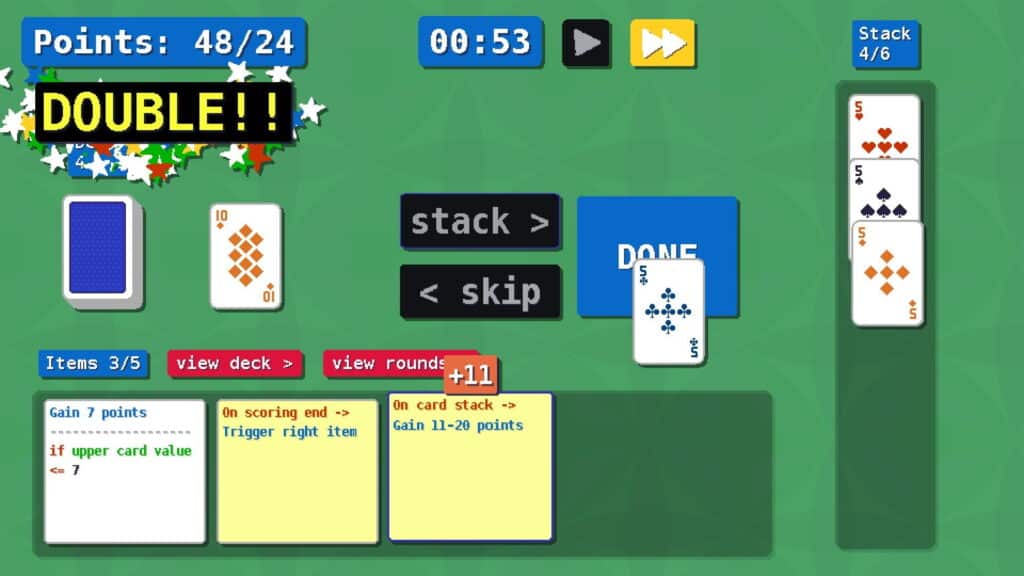
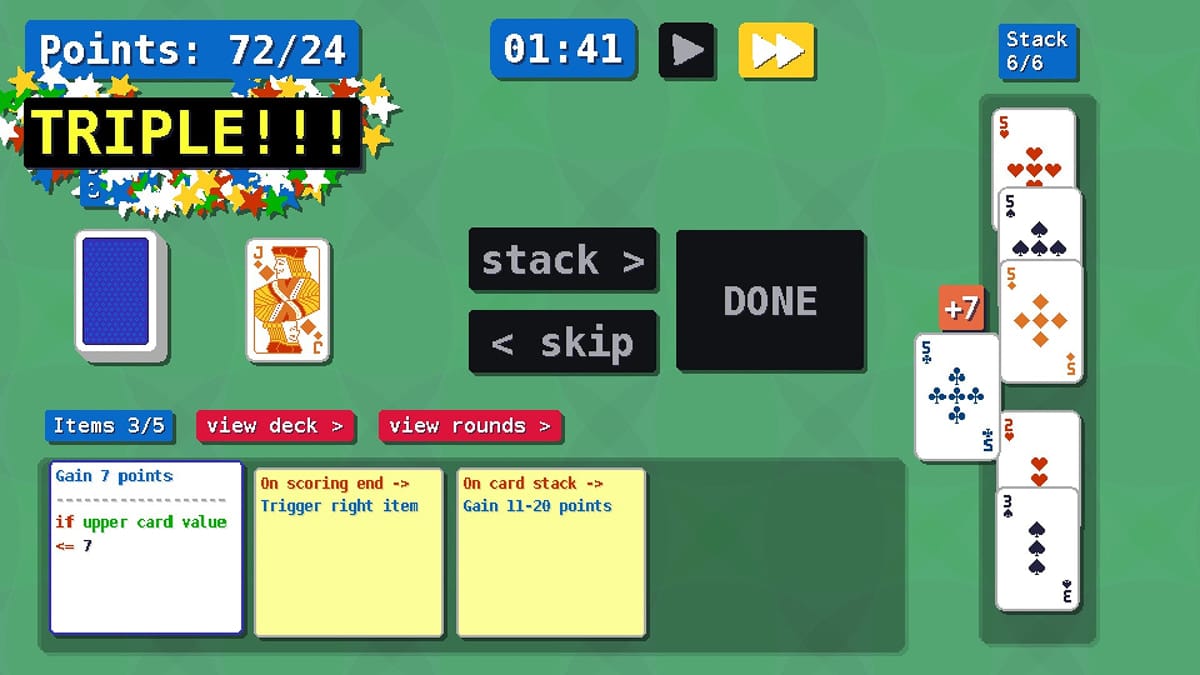
Queue Queen’s gameplay consists of several elements, most importantly, the stacking of cards to achieve points. Once entering a game, you will have a predetermined amount of time to stack six cards on the right side of the screen. Your only two options are to either commit and stack the current card for evaluation at the end or skip it and lose the card. However, something worthy of note is that the value of the card stacked does not get added to your points.
Instead, the only way to earn points is to activate items, which you can purchase between games. There are also a few other shops available that allow you to edit your deck or your purchased items. There are several colours of items in the game; the ones we will focus on here are white items.
The white items are how you will gain most of your points. As a general rule, white items give points if the currently evaluated card in your stack meets the condition written on the item. Cards are evaluated once you have completed stacking or the time runs out. Some of the items are fairly simple, but a lot of them require an immense grasp of not only the English language but mathematics as a whole.
An example could be “if uppermost card value != 7”. We attained a card similar to this early in our first run, and our initial thought was “what does != mean?”. It was then that we recalled our time learning coding and remembered that “!=” means “does not equal” in Python script. Using that, this example would mean that every card would gain the corresponding amount of points for the item if the first card you selected did not equal 7. Queue Queen features several items like this, and five items can be equipped at any given time. Meaning this game truly requires an incredible amount of thought to excel in it.
When did Queue Queen release?

Queue Queen’s release date was the 18th of January, 2026. According to the devs’ blog, there was a demo planned to be released on Steam a month before this. There is evidence of this demo existing, but it has since been removed from Steam. While reading the same blog, we discovered that the game started development around mid July 2025.
The dev states that the intention was to set “tighter limits” on themselves, and to “make it quick, make it small”. We think they achieved this well, as the game’s development cycle took under 6 months, and yet, a fun product was made. Given that Queue Queen’s price is under $10, the level of fun to be had will certainly cover that cost and then some.
Who developed Queue Queen?

Queue Queen’s developer goes by Lisisoft. They have several other games listed on Steam, all of which have a similar presentation to one another. The developer does appear to be a fan of the rogue-like genre, as including Queue Queen, 3 of their 4 listed games could be considered roguelikes. These are Glass Cannon, Gnomber, and Queue Queen. The final one, Man Pit, is a 2D platformer that uses procedural generation for its levels.
Some further searching on the developers’ social media pages revealed to us that they have a website with a dev blog about all their games. On said website, we discovered the developer’s name to be Nikoloz Otiashvili, a programmer from Tbilisi, Georgia. They appear to have been making games for around the last 5-7 years and have extensive evidence of this on their blog page.
How does Queue Queen compare to Balatro and other Deckbuilders?

When it comes to comparing Queue Queen’s gambling and gameplay to other entries into the genre, there are not many similarities. Firstly, the difficulty is much greater not only at a gameplay level, but the actual understanding required to do well is much greater than in other games. If you know vaguely how to play poker, you can play Balatro, and even then, if you dont Balatro takes good care to educate you on the rules you need to know to do well in the game.
Queue Queen has no such safety net to fall back on; as such, you will need to learn this game from the ground up. This can be quite a daunting task, considering the proficiency needed to get even moderately far in the game. Even the tutorial itself instilled great confusion into us, and as such, everything we learned, we learned by playing.
But once you progress past the point of confusion and you begin to become effective at choosing items and stacking the correct cards, this game is a whole lot of fun. And while even now we still struggle with some of the language in the game, it does supply you with descriptions of the item’s requirements before you purchase it. However, a choice that struck us as odd, this description is no longer accessible once the item is purchased. So if you do pick up this game, make sure you fully understand the items before buying them.
Overall, Queue Queen’s explanation is as surface-level as “stack cards to win,” but the level of thought required to achieve this is remarkable given the simplicity of the gameplay. While we hope this helped prepare you for the game, we don’t think we’ve covered even half of the necessary information to excel in it. As such, we can only recommend you pick this game up yourself and see if you have the skills to do better than we did.
FAQs
What is the most valuable hand in Queue Queen?
There are no hands in Queue Queen; all of your stacked cards are evaluated to see whether or not they trigger any of your items. By extension, the most valuable “stack” is highly dependent on the procedurally generated items.
Is Queue Queen gambling?
While there are elements of luck in Queue Queen, it’s hard to argue that it’s gambling. The closest you get is risking skipping cards that may net you a higher score, or taking risks with the items in the shops. Importantly, no real money is used in Queue Queen.
Does Queue Queen end?
While a run of Queue Queen can conclude, there are several new game plus modes that add extra restrictions to make further runs harder. As such, this game still has plenty of content even after completing a run.
What defines a deckbuilder?
A deckbuilder is often defined as a game in which, throughout the course of gameplay, new items and upgrades are added to your available repertoire of options, in most cases, being a deck of cards to which you add additional cards.
Is Queue Queen just a Balatro clone?
No, not at all. While cards are used in both games, the similarities end there, as Balatro’s gameplay is entirely rooted in poker, while Queue Queen’s mechanics are entirely original.
References
- Queue Queen Devlog (Nikoloz)
Latest Gaming Articles
All Articles