



Puzzling (Mis)adventures: Volume 9 – Fez, Thomas Was Alone

Thomas Was Alone
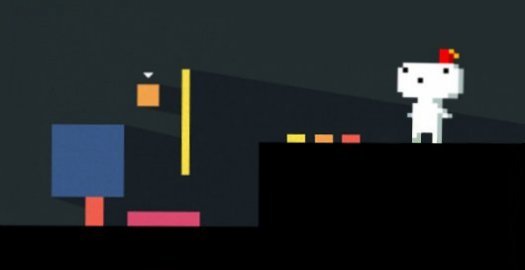
The biggest challenge Mike Bithell’s A.I. liberation story poses isn’t gravity-defying platforming, or the multi-character approach to puzzle-solving. The most important hurdle players will have to overcome in Thomas Was Alone is to suspend disbelief and accept that a game featuring a cast of squares – and I mean quite literally rectangles of varying size, color, and movement prowess – can be an interesting and emotional experience. If you can accept this in a game whose engaging storytelling demands a surprising top billing, the intuitively implemented universal motifs of friendship and loyalty make all concerns about graphics and dexterity demands largely irrelevant.
Thomas Was Alone is a game about an artificial intelligence who becomes self-aware one day as he moves through the digital confines of his matrix. With his newfound consciousness, the A.I. pixel (named Thomas because… well, simply because he is and that’s how things are) finds that he is red and rectangular, with a penchant for jumping and falling. He also begins to take note of his surroundings and the way the environment seems to react to him and evolve, forcing him to develop more advanced methods of navigating around obstacles in his path, always moving up and to the right (because that’s traditionally how one makes progress in such situations, it would seem). Having attained a state of conscious self, Thomas resolves to find a way to leave his world of operating systems and binary code behind to discover what lies beyond it in the real world. In the process, he becomes the de facto leader of a digital exodus for all others of his kind.
Before things become too complicated, Thomas meets others like him, such as the sullen Chris, a stubby orange rectangle, and over-confident John, who is able to leap great distances. Each character has his or her own personality traits, sometimes fleshed out through a bit of backstory, and their own physical attributes with respect to size and proportion, offering different abilities to aid in the solving of puzzles.
Take, for example, Claire, a large blue square who moves slowly and can’t jump high enough to clear most obstacles. When Thomas first meets her early in the game, she is in the process of slowly falling towards a watery grave, reconciling herself to her fate and lamenting her sad existence. When she hits the water, however, she discovers to her amazement that she alone has the ability to float. This realization gives her a boost of self-confidence and she becomes – in her own mind – a superhero. From this moment on, she becomes an invaluable part of the team, often ferrying her companions to safety across watery stretches.
In this way, the various characters in Thomas Was Alone have unique attributes which have to be used in different combinations to avoid bottomless pits and spike traps and proceed through the game’s 100 stages (broken into ten levels, each with its own narrative focus). Some characters fit into gaps others would not, while each one has a different jump height, necessitating creative problem-solving to get the entire team up and across tall ledges and platforms. Later in the game, inverted gravity, swappable abilities, and color-coded switches that can only be activated by the matching character further complicate things.
The size of your party grows with each new character you meet, requiring new strategies to safely advance the entire group. The actual characters you control vary from puzzle to puzzle, sometimes putting the whole group together, other times separating only a few select ones for the level. New characters are introduced throughout most of the adventure, almost to the very end, all of whom play a vital role in the ongoing narrative.
Not every stage provides a brain-bending challenge though. Some exist solely as narrative moments, giving you a simple task to perform while developing the characters’ inter- and intrapersonal arcs. This is where the real joy and catharsis of Thomas comes into play. While you won’t spend a ton of time with these characters (I’ve played through the game about three or four times now, and a quick run-through takes between 1-2 hours), they are all charming and well written, and I quickly found myself picking favorites, not based on how useful they were but on who they were – to be sure, an odd feeling to have about a minimalist game of squares in the age of HD graphics. I found myself cheering these little guys on as they conquered their fears and fell in love, lamented as they suffered. In the brief span of time that I knew them, I was able to connect with this cast on a level few games allow.
Of course, with all this talk about the power of story and characters, it’s important to recognize two of the major forces in driving the emotion home: the voiceover and music. While the characters have their distinct personalities, not one of them actually speaks out loud in-game. Since they can’t emote (being squares and all), all communication is handled by the narrator, who comes in at preset moments throughout each level to interject sometimes-quippy, sometimes-poignant lines of dialog about the various characters and their interactions. British comedian Danny Wallace infuses these moments with a dry sense of wit as the narrator, a role that earned him a BAFTA award.
The narrator’s asides are essentially the only way of relating to the protagonists and experiencing the story, and are written in a way that keeps each character’s developing sense of self in mind. For example, when players first meet Laura, a flat, pink rectangle lying on her side, she’s a depressed loner with abandonment issues. Accordingly, all narration presented on her behalf mirrors her distrust and standoffishness towards others in the group. Similarly, as the game starts, Thomas begins to make observations about the curious design of the world, pointing out tropes of platform game design in a self-deprecating, tongue-in-cheek manner. Occasional references to popular culture are strewn in here and there for good measure, like mentions of specific YouTube memes, or one character being sorry that he’ll never get a chance to actually meet Nathan Fillion.
Composer David Housden provides an outstanding soundtrack to accompany the characters on their journeys, mixing electronic bleeps and blips with a serene yet surreal sound that aptly paints a virtual electronic world. Each stage has its own theme, consisting of several interweaving tunes that procedurally mix throughout the level to create a consistent yet always changing soundscape. As characters enter and leave the game’s story arc, the music ties their relationships together and invites the player to experience their journey with them.
Though Thomas will be a quick game for seasoned platforming veterans, it is designed very much with novices of the genre in mind. In fact, I’ve already gotten several non-gamers at home playing it! The controls, like the graphics, are quite simple; each character can move left or right and jump, albeit to varying heights. Aside from horizontal movement and a jump button, the only other action necessary is to cycle through your current array of characters, as only one can be controlled at any given time, and you can switch any time you like. The keyboard controls are very intuitive on PC, while gamepad control is also supported.
The stages feature a gentle learning curve, with new concepts such as double jumps (and even just simple jumps, period) being introduced slowly and in a self-aware way, often with multiple stages to safely practice the skill while the narrator cheekily addresses the fact that one character can’t quite seem to reach the same platform another one can, for instance. Should a particular challenge still prove too difficult to nail on the first try, respawn points sprinkled throughout the stages allow your current character to rejoin his comrades and jump right back into the action if you get too close to a spike trap or fall into the water.
Beyond this, Thomas Was Alone offers up a bit of replay value in the form of hidden trophies for completionists, and an optional game-length designer commentary by Bithell himself, offering background on level design, anecdotes, and general insight into the designing process.
While Thomas Was Alone is a puzzle-platformer through and through when seen on-screen, it also transcends simple categorization. Offering a diverse cast of characters (if one cares to dig beyond what’s on the surface) and an engaging story on par with other big-name titles, Thomas is well worth checking out. While you won’t find flashy graphics here, its minimalist look and beautiful score give it a very different kind of charm – one that shouldn’t be missed by anyone looking to get lost in a good story.
Latest Gaming Articles
All Articles