



Puzzling (Mis)adventures: Volume 8 – Nihilumbra, Grimind

Grimind
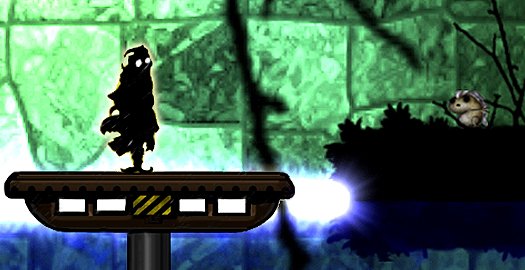
Fear, like any primal emotion, is difficult to instill into a captive audience. To feel uneasy and uncomfortable, much less afraid, while playing a video game requires more than a simple suspension of disbelief – it requires the sure and steady hand of a designer who’s tapped into what haunts the subconscious self. Pawel Mogila, designer of the physics-based horror platformer Grimind, reaches deep into his bag of tricks to makes us squirm in our seats, generally to favorable effect. What I felt while playing could be classified more as “intense nervousness” than “outright horror”, but Grimind made me seek out its well-lit areas more than once, afraid to venture beyond their protective cones of radiance.
To venture into Grimind is to take control of a short and stubby, porcupine-like, shade-wearing creature who awakens to find himself deep within a dense system of seemingly subterranean tunnels and chambers. He is all alone, save for the slithering, slimy, squishing noises caused by something hiding in the darkness, and the growling whispers of whatever unfriendly creatures lurk just on the edge of vision. Unarmed, unprepared, and without any knowledge of where you are, your task is to find the hospitable light of the surface again…or else die trying.
Grimind is packed full of movement-based puzzles; you’re constantly on the hunt for the next lever, switch, or platform that will move or operate something within the environment. This can be quite tricky at times, as your vision is limited, as befits an underground cavern. Most of the time, the majority of the screen is bathed in utter blackness, with only sections of muted illumination highlighting your general vicinity. Locales vary from wide-open cavernous rooms to narrow tunnels with barely enough clearance to walk through.
Backgrounds are tinted in warm, earthen colors: brownish reds, deep purples and darkest blues and greens abound. The only other light sources are glowing orbs set into the tunnel walls at intervals, making you strain your eyes to catch a peek of what lies all around you. The color palette is visually pleasing and literally easy on the eyes, but it leads to one of the game’s biggest challenges: hunting for levers and switches to manipulate the world around you sometimes becomes little more than a crapshoot when you can’t distinguish said lever from the black foliage surrounding and concealing it. Passages can be likewise camouflaged, making it necessary to cover every inch of ground and jump into walls on the off chance that you missed a critical mechanism – not the kind of “exploration” adventure games are typically known for.
The lack of visibility can be easily excused; one only needs to consider the mood Grimind is aiming for to overlook a few dark corners in the game. A different, albeit minor, issue arose from the game’s controls. You move your character using the W, A, and D buttons, with the S used for a few underwater diving sections. (Gamepads are also supported.) Moving the on-screen mouse cursor swings the camera in the indicated direction, and pressing the left and right mouse buttons causes you to grab and throw objects, respectively. It sounds basic, yet there were two key moments in the game that left me absolutely nonplussed for lack of knowing how to get around an obstacle. This wasn’t due to an especially devious puzzle, but rather to insufficient cues for how to get my character to perform a required action.
Grimind gameplay demo
Throwing items in a desired direction, as it turns out, has absolutely nothing to do with which way you’re facing or your location, and everything to do with where the mouse cursor is in relation to you. At all times, your character (I’ve taken to calling him Grimind) will throw objects in an arc following the on-screen cursor, which was left for me to discover on my own and caused me to get hung up on a couple of puzzles. The same is true late in the game, where the placement of the cursor directs a group of creatures following your commands. While seeming like a simple gripe that would have been (and was) easy to figure out on my own, it would have been even easier to include directions or at least a visual cue to avoid this blunder.
Where the wonderfully creepy soundscape (a score is nonexistent; instead you’ll be listening to atmospheric background noise) set me on a nervous edge, it was Grimind’s utter vulnerability that amplified the scares, turning even a minor enemy encounter into a potentially lethal showdown. Grimind’s sole adversaries, for much of the game, are little red-eyed devilish imps or sprites, which chitter away in the shadows, then suddenly and without warning, amid cacophonous barks and bellows, throw themselves en masse at you. Typically, your only hope for survival lies in running, though by the time you see the hordes descending on you it’s usually too late already. Your only means of fighting back: the little buggers detest bright light – luring them near a strong light source will instantly deteriorate them into nothingness. Of course, strong light sources are few and far between in this subterranean kingdom. Even the rare times when Grimind has a portable light source to help him survive are little better, as he is usually greatly outnumbered, and even just a few hits will swiftly end his life.
Luckily, automatic checkpoints are spread liberally throughout the game’s fifteen chapters, never starting you back too far from where you died. Likewise, there is no limit to the number of lives you have. Once a chapter has been reached in the campaign, it is then possible to replay it at any time directly from the main menu, offering you a chance to find and uncover the secret area, one of which is hidden within each chapter.
Platforming itself is kept at a manageable difficulty. The usual pitfalls (pun wholeheartedly intended) like bottomless pits, disappearing or crumbling floors, scrolling or timed stages, and the like – generally used to jack up the level of intensity of platforming – are largely absent here. Instead, the platforming takes a back seat, serving more as a means of moving between puzzle-solving sections. The most challenging moments you’re likely to encounter involve jumping between vines, timing it to take advantage of their swinging momentum to carry you further, and maneuvering an airborne platform through corridors lined on top and bottom with deadly spikes. This is perhaps why the game’s boss – the only boss in the entire game – is disproportionately more challenging than what came before, since he requires staying airborne by climbing and jumping from vines as both a mechanism of defense and a means to attack.
Any issues caused by its cluttered visibility fit the game’s mood and are easily overlooked. Minor complaints about unclear controls are likewise quickly forgiven. I did, however, take more issue with what I perceived to be an ambiguous ending to the story, sketchy and paper-thin as it was. Having bested all puzzles and made my way through one area after another in order to return to the surface world, and after vanquishing the end boss I was no closer to understanding his motivations and goals – or even who or what he was. Even the one or two plot twists along the way fail to receive any kind of payoff, making the whole narrative seem like a bit of an afterthought. Worse yet, completing the game fails to answer any of the tantalizing questions posed by the game’s trailer: Who am I? How did I get here? For that matter, where is ‘here’?
Grimind trailer
Playing at a rather leisurely pace – and having gotten considerably stuck once or twice along the way – my game time clocked in at somewhere just upward of five hours. That’s no small time investment for such an ambiguous finale. So rather than expecting Grimind to pay off once you reach the end, instead take it as a complete package from beginning to end. The narrative offers little in the way of incentive to get going or reward for reaching its conclusion, but it does provide plenty of wondrous moments along the treacherous, dimly lit way.
Latest Gaming Articles
All Articles