



Puzzling (Mis)adventures: Volume 5 – Unmechanical, Snapshot

Snapshot
Taking photos is all the rage these days. With a digital camera in every smartphone, we’ve become a society of shutterbugs that could put the paparazzi to shame. And why not? It’s so easy and fun: all you need to do is point and click… That’s certainly a familiar exercise for adventure fans, and it’s exactly what makes it such an ideal gimmick for a game, so indie developer Retro Affect has done just that in its charming but surprisingly challenging puzzle-platformer Snapshot.
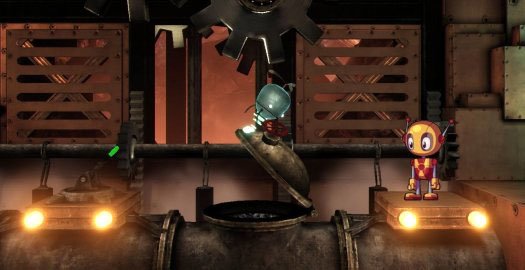
Snapping pics alone wouldn’t make for much of a game, of course, so here photography takes on a whole new dimension – literally. In the hands of an adorable little robot (or more accurately, in your hands on its behalf), the camera not only replicates an image, but captures the object itself on film to be used elsewhere later. You’ve heard about those tribes that think getting their picture taken means having their souls stolen? This is something like that.
In Snapshot, a three-photo storage slot acts basically like an inventory. You can take pictures of anything, but only particular objects can be physically caught on celluloid. Armed with this unique ability, the goal is simply to guide your bot to the end of 50-odd standalone levels, collecting stars and snapping one unique item per level if so desired along the way. At first both the objects and obstacles are very simple, to ease you into the gameplay mechanics. There’s nothing complicated about moving and stacking blocks to help you reach high ledges. But very soon the dilemmas become much more involved, and you’ll need a variety of new photogenic items to overcome them.
While the game is entirely built around its lone picture-taking conceit, it’s very good at continually doling out new challenges and methods of approaching them. For super-high walls, a spring pad will do the trick, while an elephant can push stubborn heavy blocks, and puffy white clouds help bridge impassable gaps. You can even carry teleportation doorways that open to their twins elsewhere in the level. The further you get, however, the more abstract the conundrums. You’ll need to master gravitational rings across spiky pits, ride moving platforms that constantly sink under your weight, and roll snowballs to increase their mass, to name just a few. You’ll also encounter mystical monkeys that summon timed walkways, link balls of electrical currents, and eventually clone yourself.
Even with your magic camera, you can’t just do whatever you want wherever you want, mind you. Often items you need or have to influence are trapped in no-photo zones, forcing you to think more outside the box. Doing so often means factoring real-world physics into the puzzle-solving equation. Pressure plates may be out of reach, while distant objects too heavy to move may need to be rammed with projectiles. What if the level doesn’t have any projectiles? Then you’ll just need to make your own with the inanimate objects available to you. Your sole means of manipulating photos is rotating them before replacing them in the environment, so you must correctly angle monster-spewn rocks, exploding bombs, and even gusts of wind to maximize their usefulness. This constant variety keeps the gameplay fresh, and just when you think you’ve got the hang of one skill, you can bet it’s nearly time for the next.
But where Snapshot largely succeeds as a puzzle game, it’s far less effective in its platforming elements. The bot can only run (slowly), jump (lowly), and cutely pull his antennae down to crouch through narrow passages. That’s okay, as it keeps the focus squarely on mental acuity rather than the protagonist’s physical prowess, but all too often the game relies a bit too much on the player’s own dexterity. Placing photo items mid-jump to propel yourself even higher is tricky at the best of times, but the game further stacks the deck with learn-by-failure exercises that punish you by making you start the stage over from the beginning. In levels with immobile spitting enemies, a health bar appears that can withstand a number of hits, but there are plenty of instant-death spikes and drops to contend with as well. It’s also easy to find yourself in an unwinnable state if you or an item fall in just the wrong way.
Adding to the frustration is the fact that any collectibles you’ve gathered are lost with each level restart. Often the toughest challenges are reserved for the bonus photo item or least accessible stars. That’s perfectly logical (though you won’t always know that’s what you’re pursuing), but spending many minutes securing the optional extras just to make one fatal mistake offers zero incentive to bother trying it all again. There’s really no reward for doing so besides bragging rights anyway, but giving you credit for what you’ve already collected would have been far more reasonable and encouraged more exploration and derring-do.
Given the unforgiving nature of the design, there are two other features that would have really improved the Snapshot experience. The first is an “undo last move” option that would go a long way in preventing the need to repeat levels over and over again. The other is a “show map” option, or at least a scroll feature. Facing the unknown is an important aspect of pure platformers, but it’s an arbitrary stumbling block for a puzzle game. Many times I’d trigger a pressure switch only to have no idea what occurred, while other times it’s impossible to know whether a gap leads to a platform below or a game-over plummet to your death.
The controls don’t always help either. You can play Snapshot with either the keyboard/mouse combo or gamepad, both of which have their advantages and disadvantages. The early onscreen tutorial is based strictly on the former, and it’s very simple. The keyboard is used to move and jump, while left and right mouse clicks control taking and placing photos. It’s much tougher to make difficult jumps this way, however, and rotating the photos is absurdly finicky with the mouse. Both robot movement and photo rotation feel far more comfortable with a gamepad, though it’s much harder to take and place split-second photos with the right analog stick. I actually ended up alternating between the two options depending on the specific level requirements.
You wouldn’t necessarily expect such a difficult game from its colourful cartoon graphics. You’ll move from sunny lush green forests to wintry caverns at night; from lava-spewing fiery volcanoes to hi-tech lab facilities. The hand-drawn environments aren’t overly detailed, but they make for a very pleasant visual backdrop. The music has a synthesized light sci-fi feel that does the job of filling the void but is instantly forgettable. With no voice acting or even any real sound effects of note besides the familiar camera click, you could easily tune out the game’s audio entirely.
The lack of voiceovers isn’t an issue here, because there’s really no story to speak of in Snapshot. Between each of the game’s four chapters there’s a pictorial (naturally) of the robot chasing a butterfly through new and interesting scenarios, but otherwise there’s no actual narrative tying the gameplay together. That’s a shame, because even with the continual insertion of new items and challenges, the game starts to feel a bit samey after a while. It took me more than 12 hours to complete overall, in no small part due to the constant repetition of replayed levels, though I didn’t come close to gathering all the collectibles. I couldn’t even find quite a few of the secret photo items. To the game’s credit, however, it’s not necessary to finish every level to advance, so you could easily skip the more annoying stages (alas, the completist in me wouldn’t let me do the same).
For a game with really just one core gimmick, Snapshot nicely leverages its unique concept throughout a lengthy and often entertaining puzzle-platforming experience. It’s a far better puzzler than unnecessarily punishing platformer, and I found it best played in small doses rather than large ones. The longer I played at any one time, the less I enjoyed myself and the longer it took me to return the next time. But as soon as I did, I’d fall right back into a familiar rhythm of snapping pics to overcome obstacles and wondering what kept me away so long. There’s really nothing else quite like it, so if you don’t mind some (admittedly aggravating) do-overs, there’s a lot here to like. It’s anything but a snap, but it’s well worth a shot, so check out the official website to learn more.
Latest Gaming Articles
All Articles