



Puzzling (Mis)adventures: Volume 2 – Lucidity, Max & the Magic Marker, P.B. Winterbottom

Max & the Magic Marker
While most puzzles are designed to challenge the logical left half of your brain, Press Play’s Max & the Magic Marker is determined to make you use your more creative right hemisphere as well. At least, that’s the theory behind this journey through a living world of childhood drawings. In reality, this physics-based 2D puzzle-platformer is designed even for people with no artistic talent whatsoever. If sticks, blobs, and mutant doodles are as close as you’ll ever get to fine art personally, then breathe easy, grab a marker, and leap right in – literally.
In the opening comic cinematic, a young boy named Max gets a mysterious marker in the mail and unwittingly draws a monster that springs off the page and dashes into another drawing. With his newfound power, Max decides to scribble himself into the same picture in order to stop “Mustacho” from wreaking further havoc, and the chase is on. That’s really all there is to call a story, as the rest of the game is spent simply running, jumping, and inking your way through fifteen increasingly challenging levels before finally catching up with the chortling purple monstrosity.
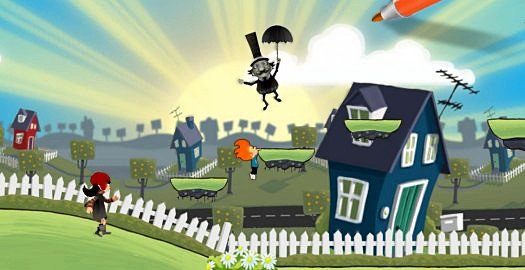
Even if your own art skills aren’t up to snuff, the developers’ thankfully were, as Max & the Magic Marker delivers a bright, cheerful visual presentation that’s a pleasure to spend time in. The scenery starts to get a little repetitive throughout the three main areas, including Max’s own neighbourhood, pirate-infested tropical islands, and a robot factory, but it’s impossible not to be tickled by the vivid colours, skewed architecture, and cartoon-like design. In a nice touch, pausing the game at any time freezes the screen in a sketch-like variation of itself, then re-animates when you resume. The jaunty tunes are fun accompaniment at first, but they become even more repetitive over time, and there’s no voice acting or notable sound effects to distract you from the endless looping.
Of course, most of your attention will be occupied by the gameplay itself, controlling both Max and the mysterious pen. With no gamepad support of any kind, Max is moved easily enough with the arrow or WASD keys, though for some reason there’s no option to remap the configuration. (No matter how many times I pressed it, the space bar would NOT become the jump key!) Max has no remarkable physical abilities beyond a light run, push, and climb, so all but the most basic of obstacles must be overcome with the ever-present marker. This giant disembodied instrument, as orange as Max’s wavy hair, is used by clicking and dragging the mouse in something resembling a functional (if barely recognizable) shape. On the Wii, Max is guided with the nunchuck, with the Wiimote handling the drawing, losing a little precision in the exchange.
Like most side-scrolling platformers, the action progresses mainly in a left-to-right direction, but you’ll sometimes reverse course and often find yourself forced to climb upwards to new heights. Assuming you have enough ink, that is. You may be holding a magic marker, but it’s not a magically refilling one, so you’ll need to routinely collect ink orbs along the way. There are two other kinds of orbs to gather as well, usually far more difficult to reach, but these are strictly for bragging rights and unlocking minor extras, so they can easily be bypassed.
Once “armed” with ink, you’ll need to make good use of it to achieve your goals. Usually the solution is fairly obvious, like building ramps and staircases to reach high ledges, or platforms for crossing chasms and riding waterspouts, but occasionally a more creative obstacle presents itself. Rope lifts, hot air balloons, and pressure plates need weight, see-saws require momentum, deadly rain storms and volcano eruptions demand makeshift shelters, and even the odd eggplantish enemy needs disposing. Since the pen is mightier than the sword, defeating them is a simple matter of dropping a newly-drawn object on them from above. (Hard lesson learned: Max is NOT Mario! Instinctively jumping on their heads equals instant death.)
Yes, Max can die, and probably will quite often in the later stages, either by plummeting into a deadly pit, being crushed by mechanical pounders, fried by lasers, or getting caught up in spinning gears. At times the camera is to blame, as there’s no manual control and there will invariably be times where you just can’t see an obstacle or your goal, imposing some trial-and-error to succeed. The game’s physics are the bigger culprit, however. While an integral and very welcome aspect of Max & the Magic Marker, the physics here tend to be a little loose, as if the game takes place in a slightly lower-gravity world than our own. It’s never insurmountable, but it wasn’t uncommon to see Max inexplicably bounce off a wall or my seemingly-solid block tower wobble around and topple over at the slightest touch.
Fortunately, dying simply results in respawning (rescribbling?) at the nearest checkpoint, which is never too far away. The trade-off for this frequency of checkpoints, on the other hand, is that you’ll have all your ink sucked away each time you pass one. Indeed, perhaps the most difficult challenge of all is rationing your precious pen juice. There’s no way to hoard away for moments of need, as the game forces you to constantly replenish your rather meagre supply. I guarantee a few temptations to backtrack just to make sure you didn’t miss a vital orb, certain you don’t have enough ink to make do. But you didn’t, and you do. The allotment is really that tight. There’s no concern about waste, at least, as right-clicking your design will erase it and suck the ink back up to try again.
There’s a challenge of another kind waiting at the end, as Max finally gets to confront Mustacho head-on in a “boss fight” level. This can actually be quite difficult, as the game’s jump command is never as responsive as it should be, and one mistake here starts you over from the beginning. In fact, though its central gimmick relies more on thought than reflex, I don’t particularly recommend Max & the Magic Marker to people with little or no action game experience, as it inevitably requires a deft hand and some steely nerve to finish, particularly as you’re leaping blindly into the great unknown, drawing as you go. Kids should have no problem, though don’t let its childlike appearance fool you, as this is a game that anyone can play.
Game length will vary widely depending on how diligent you are about collecting orbs, but most gamers can probably expect to put in 4 or 5 hours at least. Beyond that there’s very little replay value, or even much incentive to return for more collectibles, and the freeform “playground” mode is a total waste of potential. In fact, “wasted potential” was a recurring thought the longer I played. It’s great fun to be a human cannonball, play Whac-A-Mole (with real moles!), or maneuver past a sleeping octopus in a pirate hat, but the novelty soon wears off. More importantly, rather than promote imagination, the constant ink restrictions discourage much experimentation, leaving you to ponder what you can do instead of what you could do. Even so, Max & the Magic Marker is bright, pleasant puzzle-platformer that’s hard not to enjoy, with a browser-based demo that’s well worth checking out. I could write more, but why waste the ink?
Next up: The Misadventures of P.B. Winterbottom…
Latest Gaming Articles
All Articles