



Pete Samuels – Supermassive Games

[b]Ingmar[/b]: While I’m a big fan of the horror anthology idea in games, I imagine this must be an enormous amount of work. In your case, it wouldn’t seem like you can recycle much material (locations, assets etc.) from one episode to another like other series do. Not to mention that each of your titles will have narrative branching and performance-capturing. Please give us an idea of the production process of the series and the challenges you expect to arise.
[b]Pete[/b]: It’s not an insignificant challenge, for sure. As I’ve said, having multiple titles for the series in development at the same time is key to the Anthology’s success. If the release dates are more than a year apart then it kind of defeats the purpose of building it as an Anthology, so our aim is to release two games per year. Each game requires two or three performance capturing sessions of three or four days for voice and face capture, and many body-mocap and stunt shoots. We’re hitting a beat of six months story development, six months game design, six months production and six months post-production and editing…approximately…for each game. It’s quite a pace and it’s fairly constant, so looking after the welfare of the team is a key priority for us.
.png "Screenshot for Pete Samuels – Supermassive Games")
[b]Ingmar[/b]: You’re using a different engine than you did for your previous games. What kind of pros and cons have you encountered so far when it comes to the Unreal Engine 4?
[b]Pete[/b]: Man of Medan is our first multiplatform game (PS4, Xbox and PC) and we needed to move to a proven multiplatform engine. UE4 gave us a great deal of ‘out-of-the-box’ advantages. We’ve been using UE4 for a few years now and, like any new engine, we’ve had to work hard to purpose it to the things that are important to us in our games. We’ve built substantial tools and systems to help us with that.
.png "Screenshot for Pete Samuels – Supermassive Games")
[b]Ingmar[/b]: It would be fascinating to get a better understanding of your performance-capturing process. Can you walk us through a standard filming session, and the process as a whole?
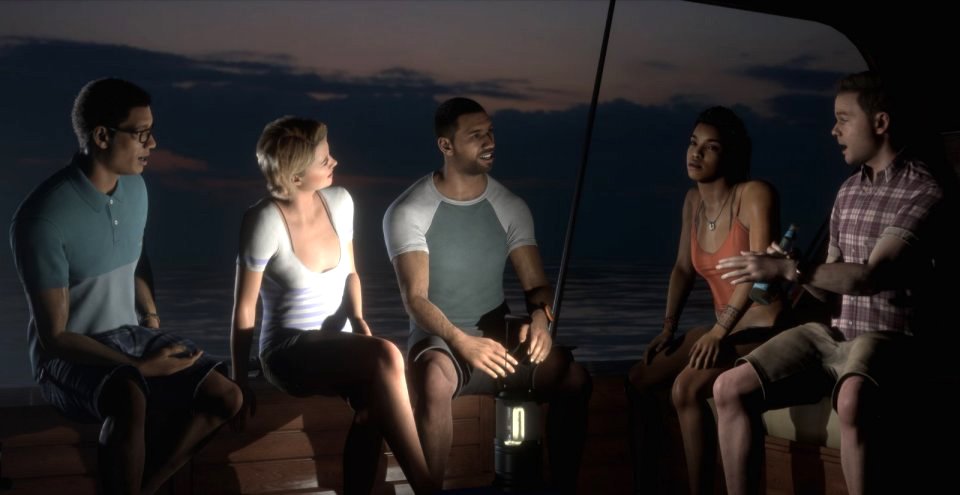
[b]Pete[/b]: First thing to say is that we capture face and voice in one process with our cast of actors, and body as a separate process using specifically trained motion-capture and stunt performers, then ‘piece’ the two together in Unreal. We go to our ‘performance’ (face and voice) shoots armed with the game’s script, mood boards and full storyboards for every scene so that the actors get a full appreciation of the environment, the pace, and where each scene that they’ll shoot fits into the overall scheme. Of course, they’ve already seen the scripts and the full character bios, so they’ve prepared for the shoot before they arrive. We don’t expect actors to be off-book. There would be way too much to memorise in our branching narrative. We provide teleprompt for lines on the stage and, we think, run a highly efficient and productive shoot, with a professionalism that’s brought to the set by a seasoned 1st AD [First Assistant Director] from film and TV, alongside our own Production and Direction people. We always encourage the talent to bring something of their own interpretation to the character, and we record in groups, so the stage is often occupied by three or more actors at the same time, bouncing their lines off each other. It’s a lot of fun for us to see the scripts brought to life in this way and, we’re regularly told, a lot of fun for the talent.
.png "Screenshot for Pete Samuels – Supermassive Games")
[b]Ingmar[/b]: What’s your personal take on the “uncanny valley”? [The problem of human simulation being so close to realism that it draws noticeable attention to the discrepancies] Do you see it as one of the main challenges for developers working on cinematic games?
[b]Pete[/b]: It’s a challenge, for sure. Almost by definition, the closer we get to perfection without achieving it, the more ‘uncanny’ it becomes! So, we could give up, and change style, or continue in pursuit of that perfection. We’ve chosen the latter as our preferred route, and we believe that most people who play our games would prefer that. All we can hope and strive for is that the emotion we deliver through our characters overrides any imperfection. Of course, everything we do is done in run-time, not ‘canned’ or pre-rendered, and it can be one of many things that throws off the believability, such as lighting, data streaming, texture memory…all of which are managed dynamically at run-time…which increases the challenge for us. That said, we have an extremely talented and technical team here in the studio, and I believe that the results achieved by the team are pretty remarkable.
[b]Ingmar[/b]: Genres aside, when it comes to storytelling, which games from recent years have particularly impressed you?
.png "Screenshot for Pete Samuels – Supermassive Games")
[b]Pete[/b]: I’ve been impressed by so many over recent years. Great storytelling is becoming so much more prominent in all game genres and more and more studios are employing the right talent to deliver stories well. I’m a huge fan of Naughty Dog and can’t wait for The Last of Us 2. The first was one of my favourite games of all time. Then there’s the most recent Red Dead Redemption and God of War games, and Hellblade, all of which stand out with their tremendous narratives.
[b]Ingmar[/b]: Before we come to an end, what’s the latest estimated release date for Man of Medan and its follow-ups?
[b]Pete[/b]: Man of Medan will release in 2019. We expect to announce a date quite soon. The next game in the Anthology will release approximately six months after that, and we can hardly wait to talk about it.
.png "Screenshot for Pete Samuels – Supermassive Games")
[b]Ingmar[/b]: Thanks a lot for doing this interview. Much appreciated, and all the best with The Dark Pictures Anthology!
[b]Pete[/b]: Thank you. It’s been a pleasure.
Latest Gaming Articles
All Articles